hyph
Copper string, fluorescent pigment, stone, clay, digital compositions (image, video), text
2014 - 2016, 2026
Copper string, fluorescent pigment, stone, clay, digital compositions (image, video), text
2014 - 2016, 2026
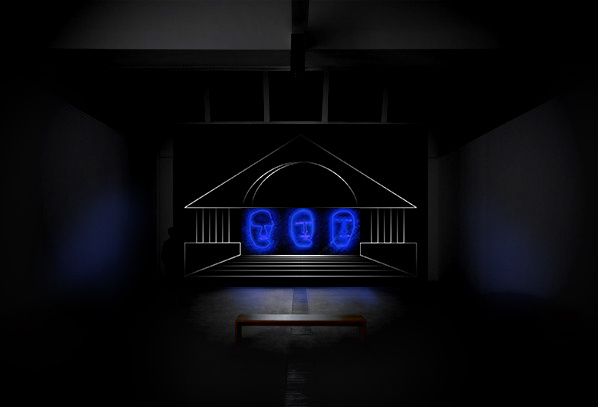
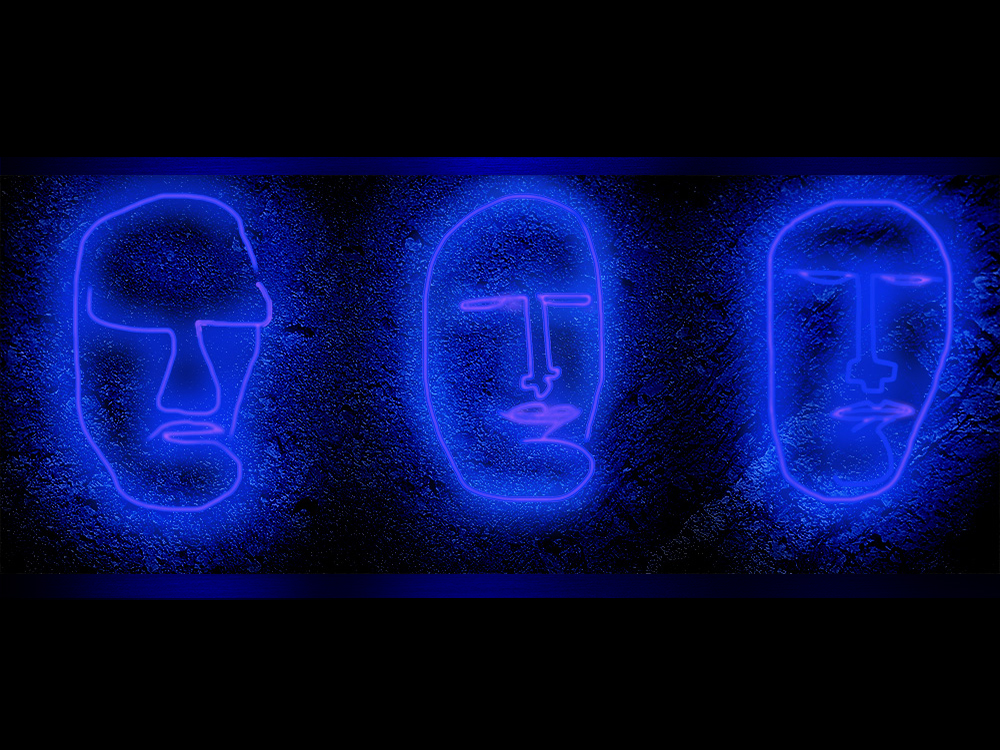
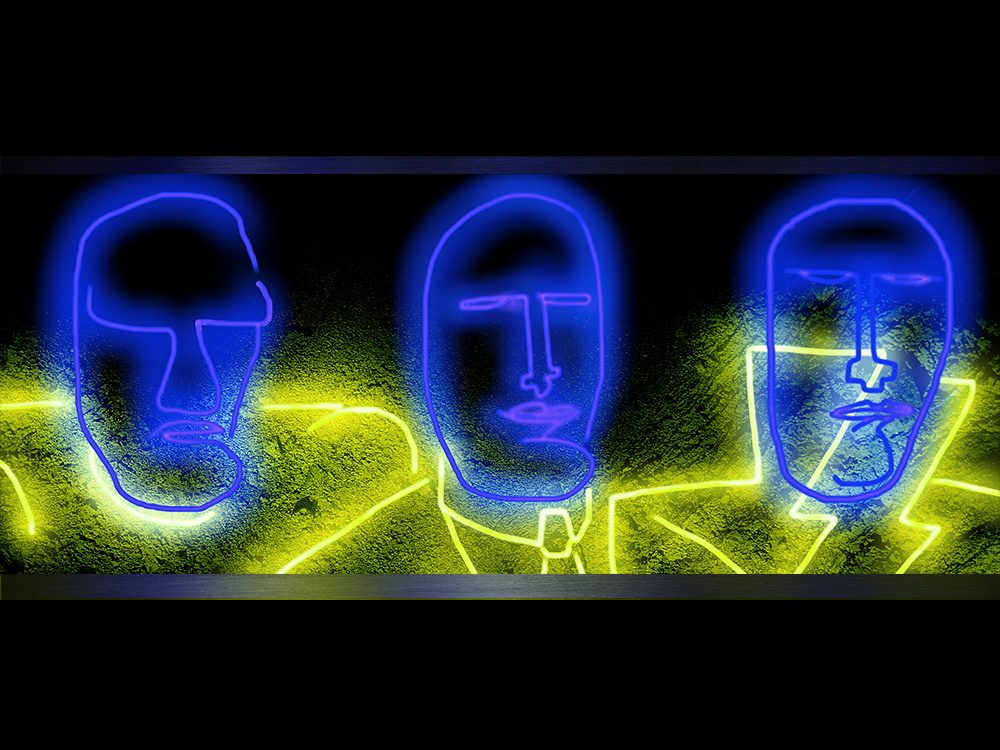
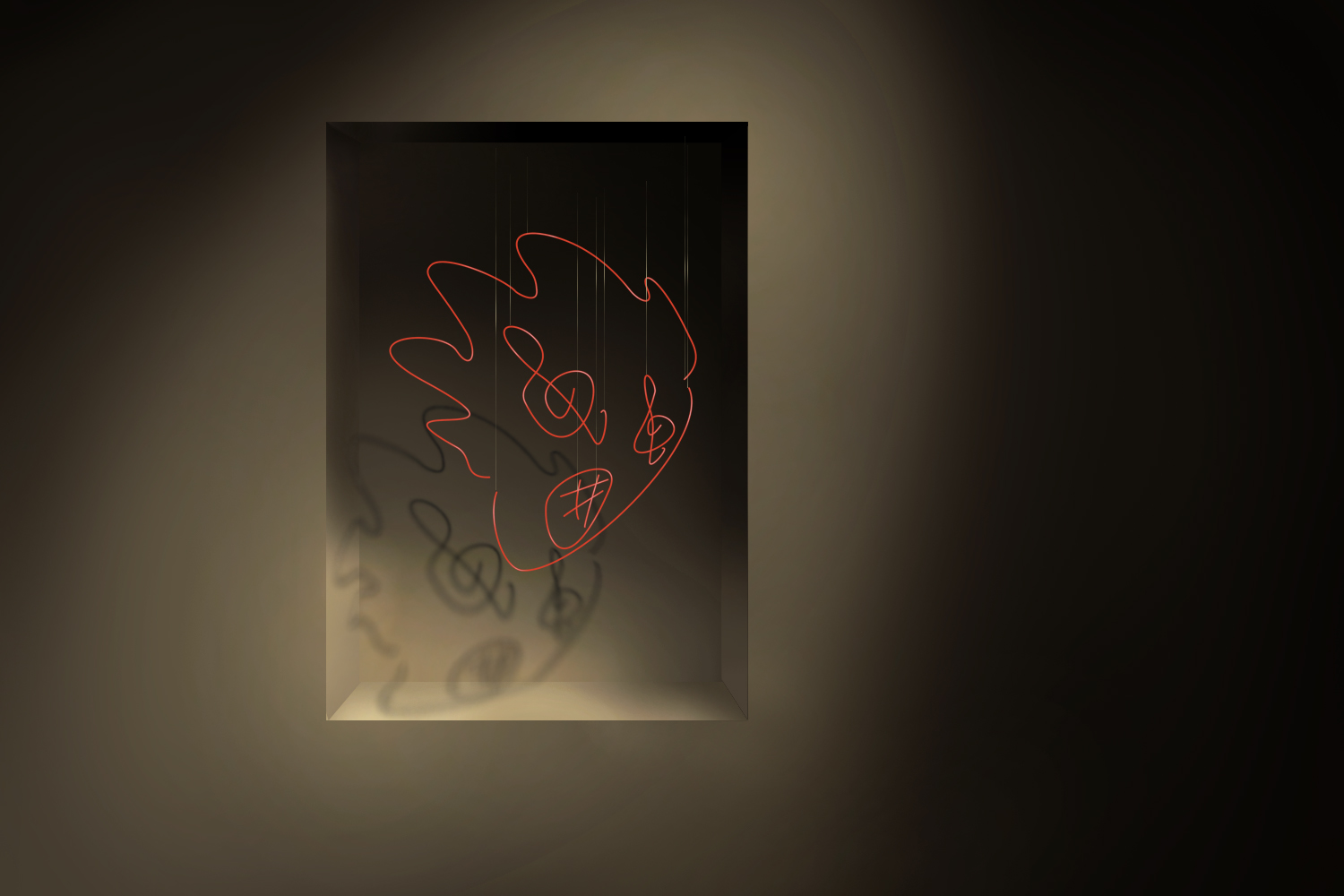
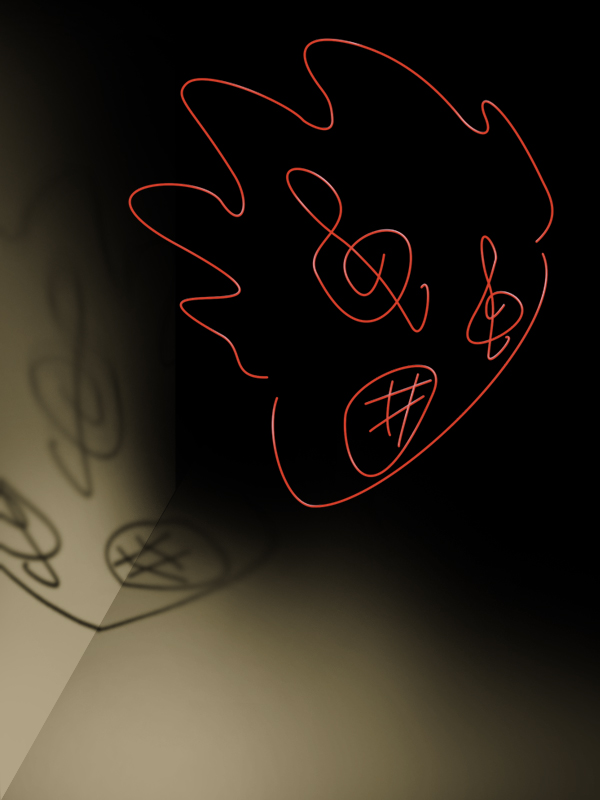
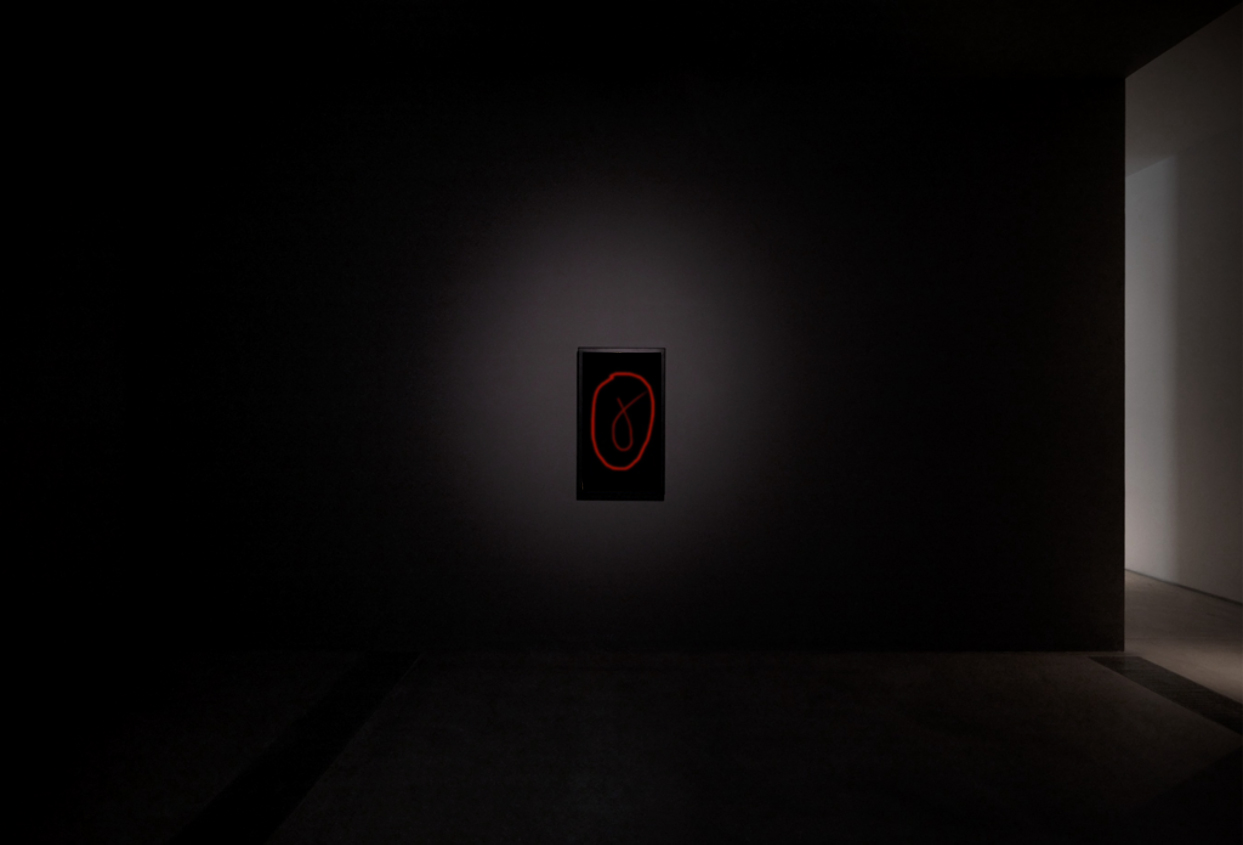
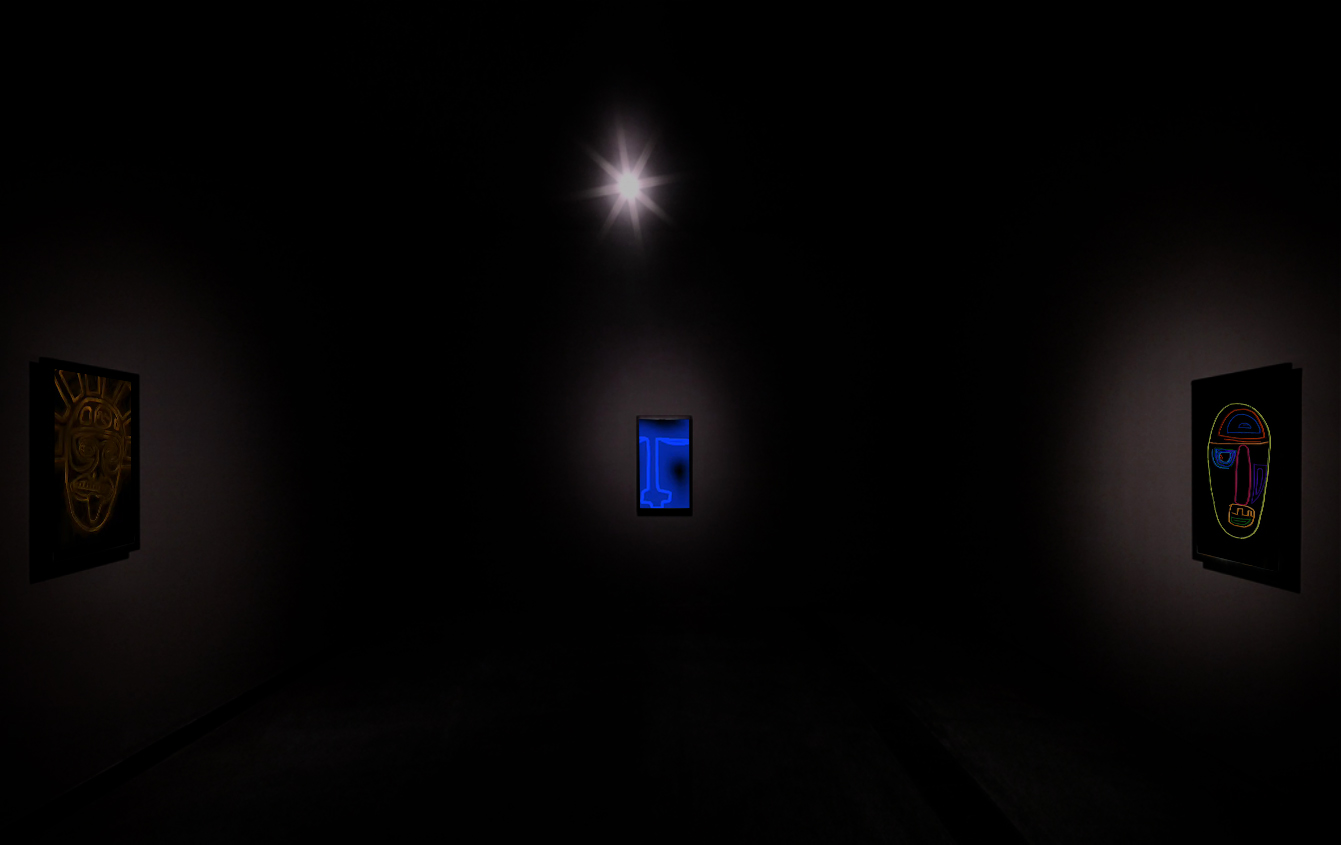
Installation view of Dyrhaug’s solo show in KODE, Bergen.
hyph 是一个从与“网”“织物”及“编织”相关的古希腊语词源中截取并重新构造的词。它并非指向某个具体物件,而更接近一种由线索、关系与相互连接构成的网状结构,正如罗兰·巴特将文本比喻成由既有文化话语交织而成的“织物”
。标题采用小写,也削弱了专有名词的纪念碑性,使其保持为一种水平延伸、没有固定中心的机制。
作品围绕一位虚构艺术家
Aasmund Eide Dyrhaug (奥斯蒙德·艾德·蒂尔豪格)及其作品体系展开,结合铜丝、石块、粘土、夜光颜料、实物拍摄和数字合成等媒介与手段,构造出一组并未在同一现实空间中真正存在的艺术作品及其展示情境。
hyph 并非从一个预先完成的人物设定或故事脚本出发。创作最初更接近一个开放的“想象力沙盒”:我暂时搁置作品必须立即获得明确主题与解释的要求,依照自己的审美偏好,自由试验形象、材料、光线、动画与空间关系。在这一近乎玩耍的过程中,视觉内容逐渐积累,并开始显现出某些共同特征。随后,我从这些共性反向推导虚构情节:某种形式可以被解释为怎样的文化影响,某些材料与技术倾向可以暗示怎样的教育或职业背景,不同对象之间又能够被编织成怎样的创作脉络。
逐渐形成的虚构设定随后反过来指导新的制作,使尚不完整的部分得到补充,并令分散的视觉实验汇聚为一套貌似连贯的 oeuvre(指艺术家的全部作品)。最终,已完成的作品再次成为修订人物经历与创作叙事的依据,使视觉创作与身份虚构在反复反馈中共同成形。因此,hyph 并不是先有故事、再由作品加以说明,而是一套形式、人物、经历与意义彼此生成、相互证明的网状结构。
当代艺术的惯性逻辑要求艺术家从个人经历、人生哲学,到创作材料与媒介、主题、表现形式、内在观念、展示方式乃至实践的发展路径,都体现出自洽的一致性;但与此同时,它又轻易为那些由肤浅而泛滥的标签拼接而成、仅仅看似自洽的人设发放通行证。hyph 一正一反,既遵循又操纵这套规则,从而讽刺了其意义生产机制及内在的虚伪。
这与福柯所说的“作者功能”相呼应:作者并非作品意义的天然源头,而是话语体系为了归类、统一和授权而建构出来的位置;话语也不是对既存现实的中性表达,而是通过一套规则生产对象、关系与可被理解的主体位置。Peter Osborne进一步以“艺术家功能”描述当代艺术中的虚构性,指出艺术权威和作品形式本身都可以通过虚构被生产出来。与之相近,罗兰·巴特将文本视为由既有文化话语交织而成的织物,并警惕以作者生平为作品提供唯一而封闭的解释。hyph 则把这些机制直接转化为创作方法:虚构作者不是作品背后的真相,而是由作品、传记、形式共性与展示机制共同编织出来的意义接口。
︎ 虚构声明
以下艺术家、机构、经历、作品关系及引述均为作品的虚构组成部分。文本中涉及的部分真实地点、历史背景与文化机构被置入虚构叙事之中,不代表相关人物或事件真实存在。
Aasmund Eide Dyrhaug(奥斯蒙德·艾德·蒂尔豪格)1968年出生于挪威斯塔万格。父亲是一名北海海上能源设施电气控制工程师,母亲则在当地中学教授音乐。成长于挪威石油经济迅速扩张的年代,家庭生活稳定、富裕而节制。1978年,十岁的Dyrhaug随父母前往比利时。父亲在那里参加工业自动化领域的技术会议,母亲则带他参观了位于特尔菲伦的皇家中非博物馆。在博物馆的展厅中,他第一次近距离接触来自中非地区的面具、雕塑与仪式物件。多年后,他将这次经验描述为自己“第一次意识到物体可以携带一种比语言更古老的精神力量”。
这段童年记忆此后反复出现在艺术家对自身实践的追述中。博物馆中的物件、昏暗而集中的照明,以及欧洲古典建筑所赋予它们的静穆感,逐渐共同构成了他对于“非洲艺术”的最初视觉印象,也被Dyrhaug视为日后前往非洲的重要动机之一。
1987年,Dyrhaug开始学习电气工程,专攻低压配电、照明控制及工业自动化。毕业后,他进入一家为北海能源设施提供控制系统的工程公司,主要负责照明、报警和低压线路设计。尽管工程工作为他提供了稳定生活,他逐渐感到技术在工业体系中只是提高效率,却很少直接改变普通人的日常经验。于是他产生了“把技术带到真正需要它的地方”的愿望。1997年,Dyrhaug加入人道主义组织 Stiftelsen Lyslinje。该组织由工程师、建筑师及能源行业从业者组成,致力于为撒哈拉以南非洲缺乏基础设施的偏远地区建立小型离网供电系统。Dyrhaug先后参与刚果民主共和国的乡村电气化项目,负责发电蓄电设备、低压线路和基础照明系统的安装,并向当地人员提供维护培训。
在其中一次项目中,团队进入了一座此前从未接入任何供电系统的偏远村庄。一间兼具教学、议事和公共聚会功能的建筑,成为村庄第一处安装固定电灯的空间。Dyrhaug后来回忆通电的那个夜晚,悬挂在屋顶下方的灯管最初只发出几次短促的闪烁,随即在黑暗中稳定亮起。光线第一次完整地照见屋顶、墙面和聚集其中的人群,也使此前融入夜色的面孔、衣物和动作骤然变得清晰。孩子们在墙面与地面之间追逐自己的影子;有人仰头注视灯管,有人伸出双手,仿佛试图确认光线是否具有温度;笑声、叫喊和彼此重复的话语在室内交错,身体则不断靠近光源。建筑并没有改变形状,却仿佛在一瞬间成为了另一个空间。他后来写道:
“在那之前,村庄的夜晚只属于火焰、煤油灯和月光。灯管亮起的那一刻,我第一次看见技术变成了仪式。电流穿过玻璃管,仿佛某种看不见的精神进入了物体;人们不约而同地向光靠近,围绕它重新排列自己的身体、声音和目光。那一刻,夜晚像是第一次被人的意志打开。那盏灯并不只是照亮了一间房屋——它重新组织了夜晚,也重新组织了所有身处其中的人。”
这一经历对Dyrhaug产生了持续而私密的影响。他开始将电力理解为一种近乎纯洁的人道主义力量。2000年返回挪威后,Dyrhaug重新进入工程行业。与在非洲参与离网项目时所感受到的直接性相比,日常工作重新变得稳定、精确而缺乏变化。他曾形容那一时期的生活是“一种被充分照明、却很少真正显现什么的现代生活”。工作之外,他开始在住宅地下室摆弄小型电气元件、旧开关、灯泡、导线和简易控制装置。这些活动最初并不具有明确的艺术目的,更像是工程师用来消磨时间的私人实验。他将铜线弯曲成人物、动物与面孔的轮廓,有时为它们连接微型光源,观察线条如何在亮起与熄灭之间获得不同形态。这些作品仅仅被Dyrhaug本人称作“小东西”或“线路练习”。铜线在其中脱离了传输电流的实际功能,却仍然保留着线路、连接和导向的视觉特征。
2003年,年轻策展人 Ingrid Solheim 受奥斯陆一个有关非洲文化交流与国际慈善实践的项目委托,对曾参与海外援助工作的挪威专业人士进行访谈。期间,她偶然看到那些由铜线、石块和微型照明装置组成的实验。Solheim后来回忆,这些对象最吸引她的地方,是它们尚未决定自己究竟属于工程、记忆还是艺术。她尤其注意到,Dyrhaug反复制造环形排列的人物、悬浮光源、面具状面孔及类似仪式路径的线条。她鼓励他将这些私人实验视为一项可以持续发展的创作实践,并协助他整理早期作品、建立影像记录以及首次在艺术空间中进行展示。
在Solheim的推动下,Dyrhaug开始重新审视地下室中已经积累的形象,并将它们与自己关于非洲、照明和技术经验的记忆建立联系。原本彼此分散的铜线人物、石块、发光物和小型电路,逐渐被组织成一套围绕黑暗、显现、群体与文明秩序展开的作品体系。Dyrhaug并未选择在创作中重现某一具体时刻,而是把通电之夜转化为一种关于光如何进入共同体的个人寓言。当表情、语言与身体动作,被重新排列为一种介于庆祝和仪式之间的群体节奏,工程项目中的技术时刻也由此获得了近乎神圣的心理意义。此后,Dyrhaug逐渐发展出以铜丝、石块、粘土、夜光颜料、程序控制照明与数字影像为核心的跨媒介实践。他的作品反复呈现形象由黑暗进入可见状态、身体被服饰和建筑秩序包围,以及线条、光源和物体在技术装置与仪式象征之间转换的过程。
Dyrhaug始终强调,他无意代表自己曾经接触的非洲社群,而只关注那些经验在自身内部留下的变化。这一立场后来成为评论界理解其作品的重要入口,也使他的工程背景、人道主义经历与形式语言,被逐渐组织为一条彼此印证的艺术发展路径。
补充信息:
比利时皇家中非博物馆的前身源自1897年布鲁塞尔国际博览会在特尔菲伦设置的殖民展区,其目的之一是宣传利奥波德二世在刚果自由邦的殖民事业。当时,267名刚果人被带到比利时,并在公园中搭建的所谓“刚果村落”——被博物馆明确称为“人类动物园”(human zoo)——内公开展示;其中七人因恶劣的生活条件和疾病在展览期间死亡。
hyph is a constructed word, extracted and reshaped from an ancient Greek root associated with webs, fabric, and weaving. Rather than naming a particular object, it suggests a network made up of traces, relations, and interconnections—much like Roland Barthes’s description of the text as a “tissue” woven from pre-existing cultural discourses. The lowercase title also diminishes the monumentality of a proper name, allowing hyph to remain horizontal, dispersed, and without a fixed centre.
The work revolves around a fictional artist,
Aasmund Eide Dyrhaug,
and an invented body of work. Combining copper wire, stone, clay, phosphorescent paint, filmed physical materials, and digital compositing, it constructs a series of artworks and exhibition settings that never existed together within a single physical space.
hyph did not begin with a fully formed character or a predetermined narrative. Its initial development was closer to an open-ended “sandbox for the imagination.” I temporarily suspended the demand that the work should immediately possess a clearly defined subject or explanation, and instead followed my own aesthetic preferences, freely experimenting with images, materials, light, animation, and spatial relationships. Through this almost playful process, visual elements accumulated and gradually began to reveal shared characteristics. I then worked backwards from these recurring features to generate the fiction: what kind of cultural influence might account for a particular form; what educational or professional background might be suggested by certain materials and technical tendencies; and what kind of artistic trajectory might connect otherwise separate objects. As the fictional framework took shape, it began to guide the production of further works, filling gaps and drawing scattered visual experiments into an apparently coherent oeuvre. Once the works had been completed, they in turn became the basis for revising and elaborating the artist’s biography and creative narrative. Visual production and fictional identity thus emerged through a recursive process of mutual adjustment. hyph is therefore not a story conceived in advance and subsequently illustrated by artworks, but a network in which forms, characters, experiences, and meanings generate and authenticate one another.
A persistent logic within contemporary art demands that an artist’s personal history and philosophy of life, their choice of materials and media, subject matter, formal language, underlying ideas, modes of display, and the development of their practice should all exhibit a coherent internal consistency. At the same time, the same system readily grants legitimacy to artist personas assembled from superficial and overfamiliar labels, provided that they merely appear coherent. hyph both follows and manipulates this logic, approaching it from opposite directions in order to satirise the mechanisms through which artistic meaning is produced, as well as the hypocrisy embedded within them.
This structure resonates with Michel Foucault’s concept of the “author-function.” The author is not the natural origin of a work’s meaning, but a position constructed by discourse in order to classify, unify, and authorise it. Nor is discourse a neutral representation of an already existing reality; through its rules and conventions, it produces objects, relations, and intelligible subject positions. Peter Osborne extends this question through the “artist-function,” describing how artistic authority and the forms through which art appears may themselves be produced through fiction. Barthes similarly understands the text as a fabric woven from existing cultural discourses, while resisting the use of an author’s biography as the work’s single, closed explanation. hyph turns these mechanisms directly into a method of production. The fictional artist is not the truth concealed behind the works, but an interface through which meaning is generated—woven together from the works themselves, an invented biography, recurring formal characteristics, and the structures through which they are displayed.
The work revolves around a fictional artist, Aasmund Eide Dyrhaug, and an invented body of work. Combining copper wire, stone, clay, phosphorescent paint, filmed physical materials, and digital compositing, it constructs a series of artworks and exhibition settings that never existed together within a single physical space.
hyph did not begin with a fully formed character or a predetermined narrative. Its initial development was closer to an open-ended “sandbox for the imagination.” I temporarily suspended the demand that the work should immediately possess a clearly defined subject or explanation, and instead followed my own aesthetic preferences, freely experimenting with images, materials, light, animation, and spatial relationships. Through this almost playful process, visual elements accumulated and gradually began to reveal shared characteristics. I then worked backwards from these recurring features to generate the fiction: what kind of cultural influence might account for a particular form; what educational or professional background might be suggested by certain materials and technical tendencies; and what kind of artistic trajectory might connect otherwise separate objects. As the fictional framework took shape, it began to guide the production of further works, filling gaps and drawing scattered visual experiments into an apparently coherent oeuvre. Once the works had been completed, they in turn became the basis for revising and elaborating the artist’s biography and creative narrative. Visual production and fictional identity thus emerged through a recursive process of mutual adjustment. hyph is therefore not a story conceived in advance and subsequently illustrated by artworks, but a network in which forms, characters, experiences, and meanings generate and authenticate one another.
A persistent logic within contemporary art demands that an artist’s personal history and philosophy of life, their choice of materials and media, subject matter, formal language, underlying ideas, modes of display, and the development of their practice should all exhibit a coherent internal consistency. At the same time, the same system readily grants legitimacy to artist personas assembled from superficial and overfamiliar labels, provided that they merely appear coherent. hyph both follows and manipulates this logic, approaching it from opposite directions in order to satirise the mechanisms through which artistic meaning is produced, as well as the hypocrisy embedded within them.
This structure resonates with Michel Foucault’s concept of the “author-function.” The author is not the natural origin of a work’s meaning, but a position constructed by discourse in order to classify, unify, and authorise it. Nor is discourse a neutral representation of an already existing reality; through its rules and conventions, it produces objects, relations, and intelligible subject positions. Peter Osborne extends this question through the “artist-function,” describing how artistic authority and the forms through which art appears may themselves be produced through fiction. Barthes similarly understands the text as a fabric woven from existing cultural discourses, while resisting the use of an author’s biography as the work’s single, closed explanation. hyph turns these mechanisms directly into a method of production. The fictional artist is not the truth concealed behind the works, but an interface through which meaning is generated—woven together from the works themselves, an invented biography, recurring formal characteristics, and the structures through which they are displayed.
︎ Fictional Disclaimer
The artist, organisations, biographical events, relationships between works, and quotations presented below are fictional elements of the artwork. Certain real locations, historical circumstances, and cultural institutions have been incorporated into this invented narrative; their inclusion should not be taken to suggest that the individuals or events described here actually existed.
Aasmund Eide Dyrhaug was born in Stavanger, Norway, in 1968. His father worked as an electrical control engineer on offshore energy installations in the North Sea, while his mother taught music at a local secondary school. He grew up during the rapid expansion of Norway’s petroleum economy, in a household defined by stability, affluence, and restraint. In 1978, at the age of ten, Dyrhaug travelled with his parents to Belgium. His father was attending a conference on industrial automation, while his mother took him to the Royal Museum for Central Africa in Tervuren. There, he encountered masks, sculptures, and ritual objects from Central Africa at close range for the first time. He would later describe the visit as “the first moment I understood that an object could carry a spiritual force older than language.” This childhood memory recurs throughout the artist’s later accounts of his practice. The objects themselves, the museum’s dim and concentrated lighting, and the solemnity conferred upon them by European classical architecture gradually merged into his earliest visual conception of “African art.” Dyrhaug would also cite the encounter as one of the impulses behind his eventual decision to work in Africa.
In 1987, he began studying electrical engineering, specialising in low-voltage distribution, lighting control, and industrial automation. After graduating, he joined a company that designed control systems for North Sea energy facilities, where his work focused primarily on lighting, alarm systems, and low-voltage circuitry. Although engineering provided him with a secure livelihood, he increasingly felt that within industrial systems technology was used principally to increase efficiency, while rarely transforming the lived experience of ordinary people in any direct way. He began to speak of a desire to “bring technology to places where it was genuinely needed.” In 1997, Dyrhaug joined the humanitarian organisation Stiftelsen Lyslinje. Composed of engineers, architects, and professionals from the energy sector, the organisation developed small-scale off-grid electricity systems for remote areas of sub-Saharan Africa where basic infrastructure was limited or absent. Dyrhaug took part in a series of rural electrification projects in the Democratic Republic of the Congo, installing generating and storage equipment, low-voltage wiring, and basic lighting systems, as well as training local residents in their maintenance.
During one such project, the team travelled to a remote village that had never previously been connected to any form of electrical supply. A building used for teaching, community meetings, and public gatherings became the first structure in the village to receive permanently installed electric lighting. Dyrhaug later recalled the night when the system was switched on. The fluorescent tube suspended beneath the roof flickered briefly before settling into a steady light. For the first time, the roof, the walls, and the people gathered inside were fully illuminated. Faces, clothing, and gestures that had until then merged into the darkness suddenly became distinct. Children chased their own shadows across the walls and floor. Some tilted their heads towards the tube; others extended their hands, as though trying to discover whether light possessed a temperature. Laughter, cries, and repeated phrases crossed the room as people moved continually closer to the source. The building had not altered in shape, yet seemed, in an instant, to have become another space entirely. He wrote:
“Until then, the village night had belonged only to fire, paraffin lamps, and moonlight. When the tube came on, I saw technology become ritual for the first time. The current passed through the glass as though an invisible spirit had entered the object. Without discussion, people moved towards the light, reorganising their bodies, voices, and attention around it. In that moment, the night seemed to be opened by human will for the first time. The lamp did not merely illuminate a building—it reorganised the night, and everyone within it.”