展览现场
Installation view
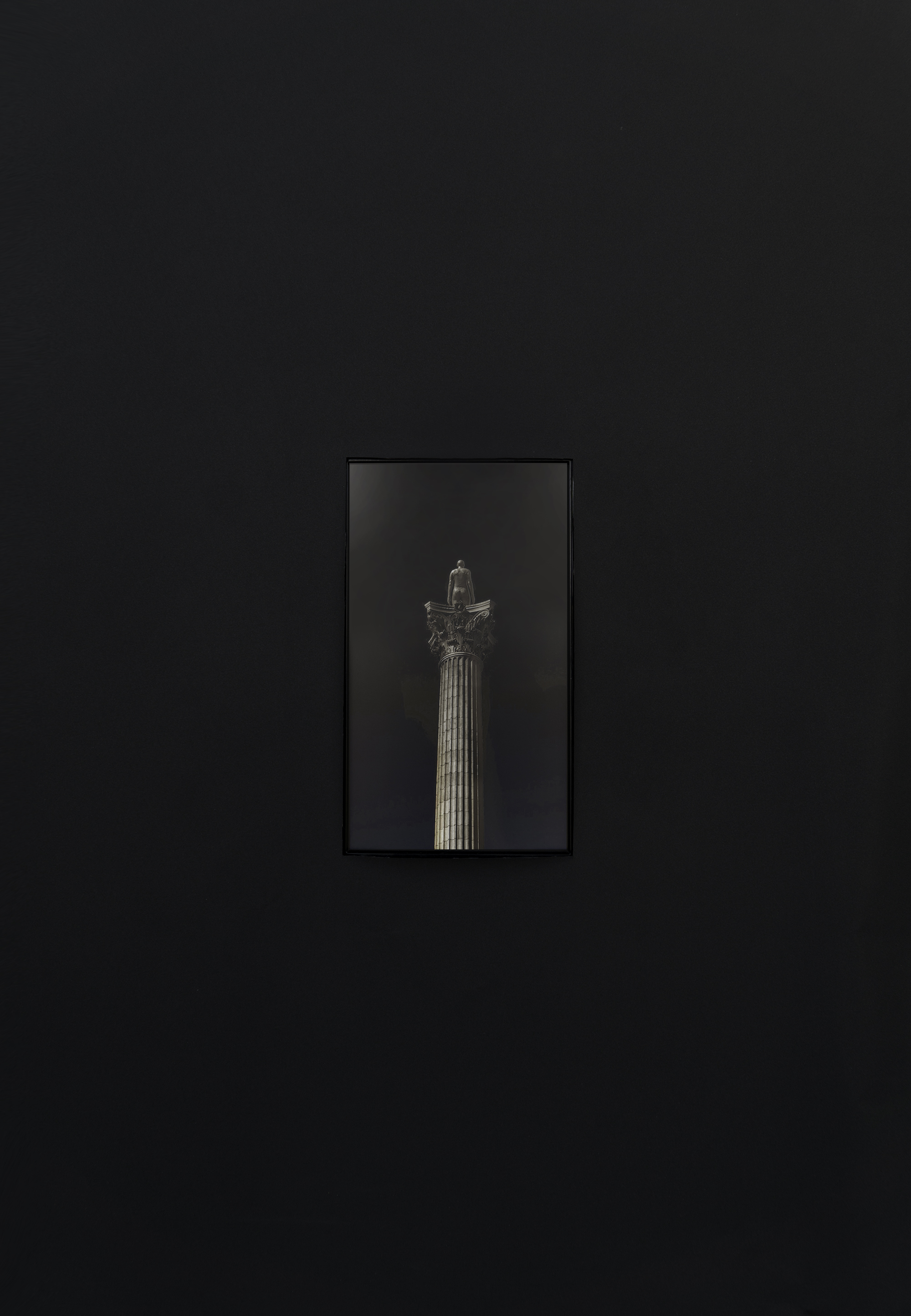
作品内置屏幕中所播放的视频内容
Video content displayed on the installation’s built-in screen
金匠之艺——橱窗陈列
2018
视频装置:木结构、聚乙烯、塑料薄膜、电子设备及混合媒介,2分31秒,循环
《
金匠之艺——橱窗陈列
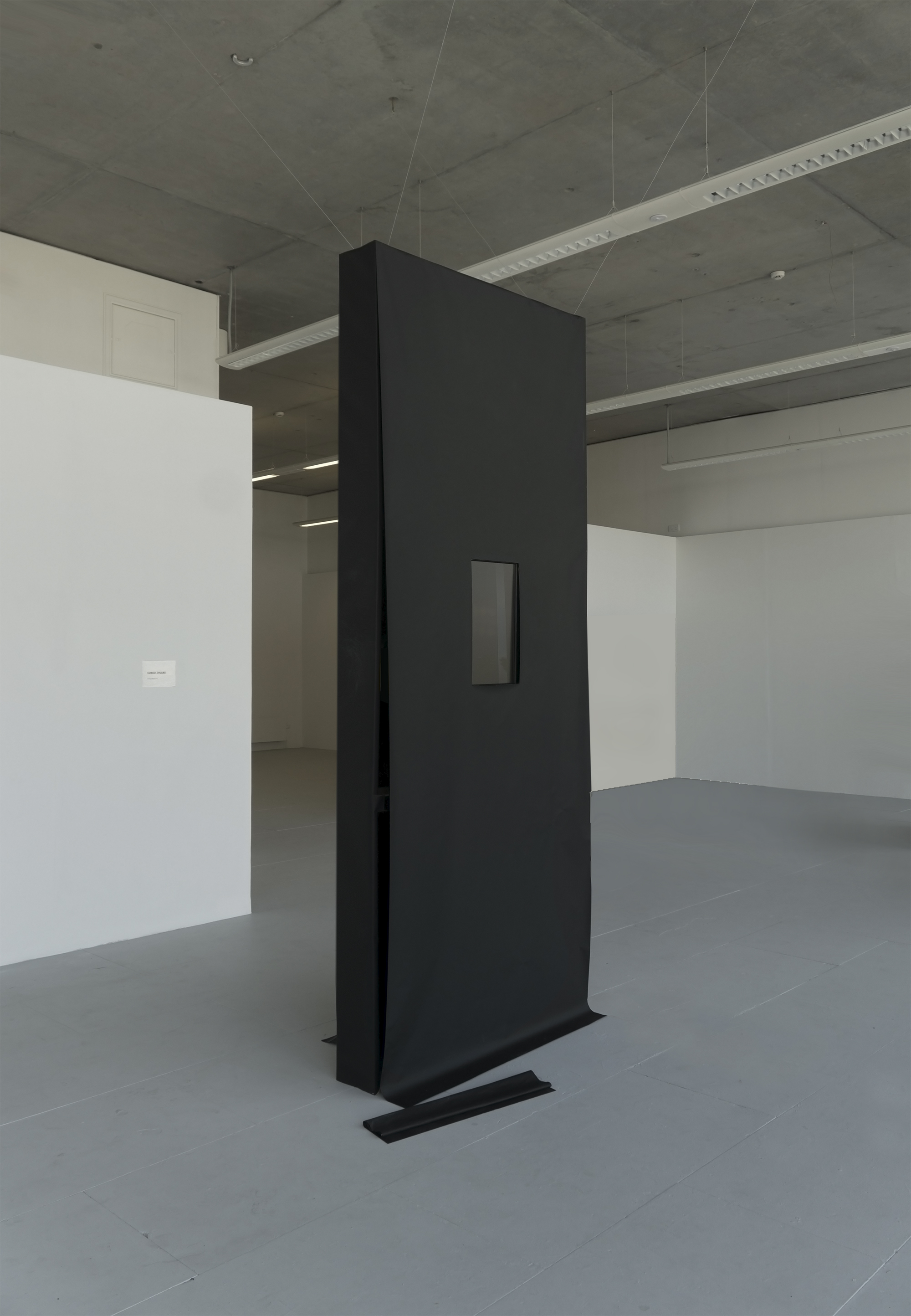
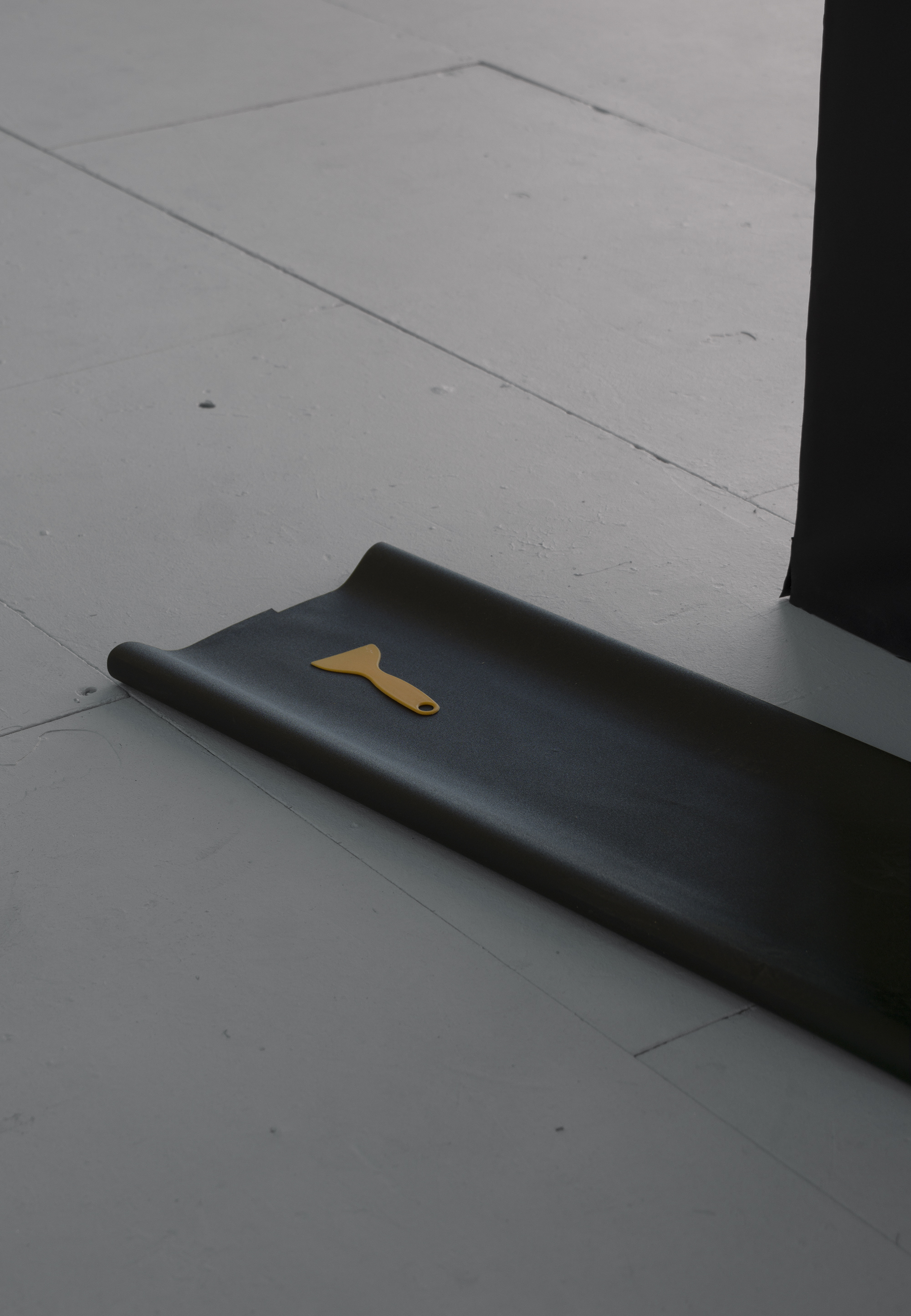
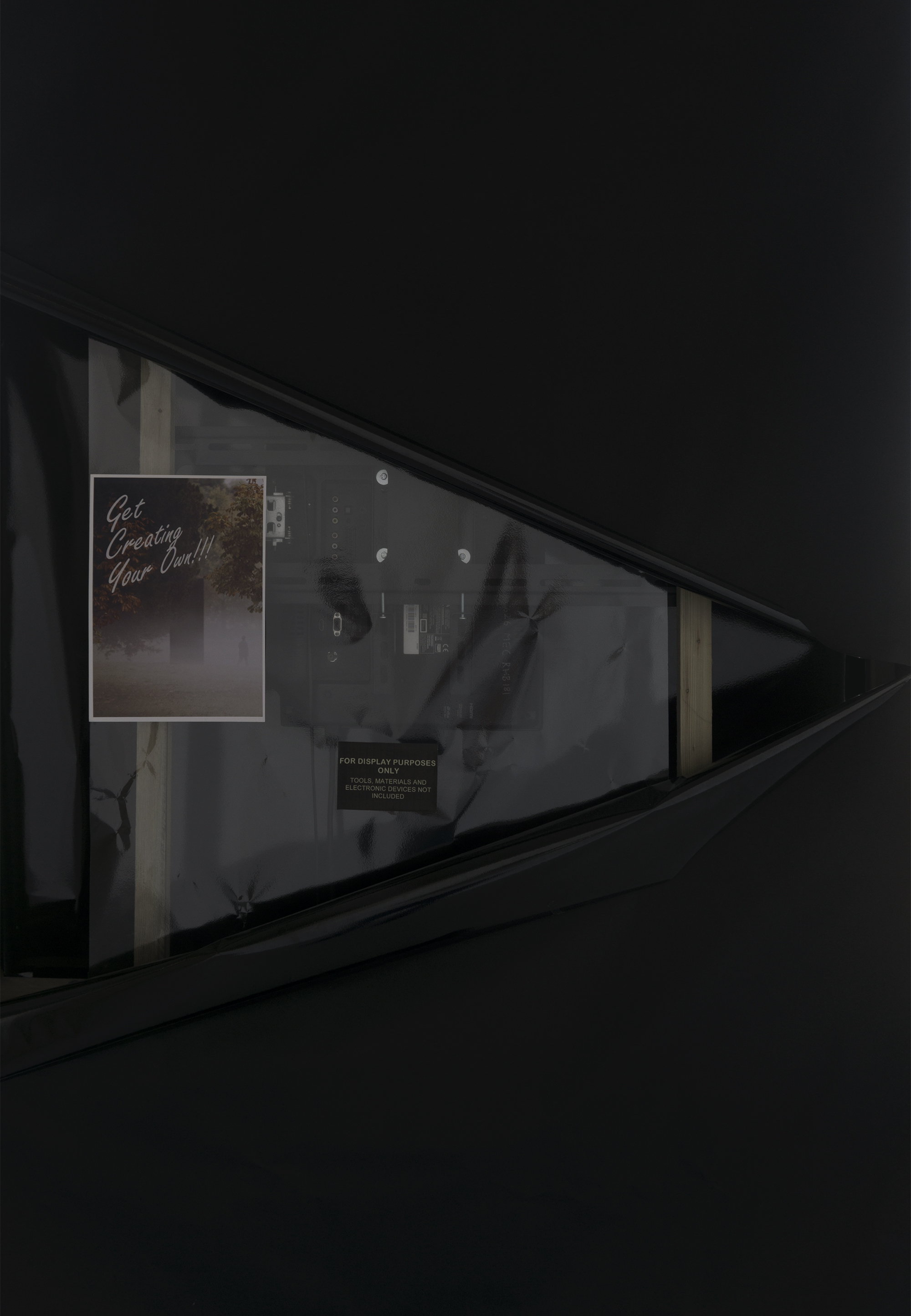
》是一件以虚构品牌为核心的视频装置。作品仿制了一个尚未搭建完成的商店橱窗道具:一块高大、黑色、近似独石碑的结构矗立于展厅中央,正面只留出一块小型竖向屏幕,循环播放四则伪电视广告。装置的正面呈现出封闭、庄严而近乎纪念碑式的形象,背面则暴露出木质支架、塑料覆膜、显示设备与连接线路、写有“Get Creating Your Own!!!”的宣传海报,以及“仅供展示,工具、材料与电子设备不包括在内”的免责声明。地面上散落着尚未安装完成的黑色构件和一件塑料工具。作品由此同时呈现为纪念碑、商品展示架、舞台布景与廉价零售道具:它试图制造权威、神秘与永久性,却不断显露出自身临时、空心而可拆卸的物质结构。
这件作品之所以采用商店橱窗、商品广告和品牌营销的形式,最直接的来源其实是我当时正在经历的现实:作为一名留学生,我支付高昂的学费,到Goldsmiths购买一项教育服务,并在这一基础上延伸出的体悟反馈到作品上。当时我也隐约感觉到,艺术教育、艺术机构、理论研究、评论出版、展览、画廊、收藏和拍卖,都运行在一套更庞大而复杂的政治经济结构中。不过,这并不是作品试图完整讨论的问题。它更像是作品背后的一种模糊直觉:这套结构并非从外部简单地控制艺术,或把艺术当作实现利益的工具;它更像一个血液循环系统,为整个当代艺术世界输送资源、价值和合法性,而艺术所生产的文化声望、新颖性、批判姿态和欲望,又反过来维持并滋养这个系统。
2018
视频装置:木结构、聚乙烯、塑料薄膜、电子设备及混合媒介,2分31秒,循环
《
金匠之艺——橱窗陈列
》是一件以虚构品牌为核心的视频装置。作品仿制了一个尚未搭建完成的商店橱窗道具:一块高大、黑色、近似独石碑的结构矗立于展厅中央,正面只留出一块小型竖向屏幕,循环播放四则伪电视广告。装置的正面呈现出封闭、庄严而近乎纪念碑式的形象,背面则暴露出木质支架、塑料覆膜、显示设备与连接线路、写有“Get Creating Your Own!!!”的宣传海报,以及“仅供展示,工具、材料与电子设备不包括在内”的免责声明。地面上散落着尚未安装完成的黑色构件和一件塑料工具。作品由此同时呈现为纪念碑、商品展示架、舞台布景与廉价零售道具:它试图制造权威、神秘与永久性,却不断显露出自身临时、空心而可拆卸的物质结构。
作品中的四则广告以夸张的营销语言,先是鼓吹艺术的崇高性,将艺术与人类创造力、文明、精神超越和不朽联系起来;继而在第二则中引诱观众自己实践创造艺术;随后再在第三则中将这种宏大愿望转化为通过购买产品获得“艺术家”的主体身份——一台名为“Goldsmith’s Art”的、声称能为消费者打印一台能够打印任何事物的3D打印机(而实际上只是在复制它自己);并在最后一则中承诺“售后服务”,保证产品效果的一致性。产品品牌“Goldsmith’s Art(金匠之艺)”影射了艺术家当时就读的Goldsmiths学院及其在英国当代艺术教育中代表性的学术传统:理论密集(批判理论、后结构主义和文化研究)、观念导向、重视话语与研究方法。作品借由此指向当代艺术制度中一套深层生产机制:学院、理论、策展、批评与展览不断承诺培养独立、原创、据批判性且不可替代的艺术家,却只是不停在同一个话语体系内部持续制造回音——产品效果一致性所隐喻的本质趋同。艺术家被鼓励去“创造自己的东西”,但这种被称为独创性的能力本身,往往已经由既存制度规定了可理解、可展示与可承认的形式。
这一生产机制与福柯在《性史》第一卷中提出的“话语的战术多价性”相呼应。福柯强调的是:话语的战术功能并不统一或稳定。话语不能被永久划分为“权力的话语”和“反抗的话语”;同一种表达方式会因发言者的位置、制度语境和力量关系的改变而被重新部署,甚至可以“以不变的形式从一种策略流通到与之相反的策略”。因此,当代艺术原本用以质疑权威、规范与既定意义的理论语言,也可能在学院、策展、批评和展览制度的反复运用中固化为新的准入规则与价值尺度,反过来规定何种作品才能被理解为当代的、原创的或具有批判性的。作品所指向的正是这种战术功能的转换:批判话语在保留其表面形式的同时,被重新部署为艺术制度进行自我复制并维持其合法性的工具;批判性也由打破规范的可能,逐渐变成艺术家必须履行的规范。
在此基础上,作品假设在Goldsmiths所代表的当代艺术系统背后存在一条隐性价值链:艺术是人类创造力、自由意志、精神超越与文明成就的证明;创造和批判体现人的自由与主体性;艺术家是高度实现这些能力的人;艺术教育负责培养这种理想的创造主体。但应警惕的是,在阿甘本“人类学机器”的分析中,“人”并非一种边界清楚、内涵稳定的自然身份;西方思想不断试图以语言、理性、意识或政治生活等条件定义人的独特性,并在区分人/非人、人与动物的过程中持续生产“人”这一概念。对人的尊严与崇高性的确认,表面上意味着文明的进步,却也可能从反面制造出不完整的、被降格的生命:当某些存在无法满足“真正的人”所应具备的条件时,它们便可能被排除在充分的承认和保护之外。
作品并不试图证明当代艺术已经直接制造了某种可以明确指认的“非人”或“赤裸生命”,而是在这一价值结构与阿甘本所描述的人类学机器之间,观察到一种令人不安的同构性:当一个体系不断为理想的创造主体增添条件时,它是否也在反面生产出欠缺原创性、批判性或主体性的“不充分者”?当艺术被用于维护人的崇高地位时,它会将“人”引向何种境遇?
补记:后来读到Mark Fisher
这件作品之所以采用商店橱窗、商品广告和品牌营销的形式,最直接的来源其实是我当时正在经历的现实:作为一名留学生,我支付高昂的学费,到Goldsmiths购买一项教育服务,并在这一基础上延伸出的体悟反馈到作品上。当时我也隐约感觉到,艺术教育、艺术机构、理论研究、评论出版、展览、画廊、收藏和拍卖,都运行在一套更庞大而复杂的政治经济结构中。不过,这并不是作品试图完整讨论的问题。它更像是作品背后的一种模糊直觉:这套结构并非从外部简单地控制艺术,或把艺术当作实现利益的工具;它更像一个血液循环系统,为整个当代艺术世界输送资源、价值和合法性,而艺术所生产的文化声望、新颖性、批判姿态和欲望,又反过来维持并滋养这个系统。
多年以后,我读到Mark Fisher关于“资本主义现实主义”的论述,才意识到,他早已为这种模糊感受提供了一套清晰得多的语言。Fisher所说的资本主义现实主义,并不只是资本主义作为一种经济制度的现实存在,而是一种几乎覆盖整个社会、甚至超越意识形态的认知氛围:资本主义被默认成唯一可行的现实,其他社会组织方式则逐渐变得难以想象。它进入教育、文化、公共机构、日常生活乃至人的欲望和自我理解之中,使市场竞争、绩效评估、品牌经营和投资回报看起来像是所有领域都必须服从的自然规律它不需要压制批判,而是容纳、展示、教授甚至出售批判。那些以独立、反抗和另类为名的文化形式,并不必然处于系统之外,也可能已经成为系统生产新鲜感、维持活力并更新自身的方式。
2018年创作这件作品时,我并没有读过Fisher,也不知道他曾经就在Goldsmiths任教。后来才发现,这些尚未成形的直觉与他的思想存在如此明显的共振。也正是在那时,我才得知Mark Fisher已于2017年离世,就在这件作品完成的前一年。这样的思想相遇来得太迟,因而也带着一种特别的遗憾。
Goldsmith’s Art - A Window Display
2018
Video installation
Timber framework, polyethylene, plastic sheeting, electronic equipment, and mixed media
2 min 31 sec, loop
Goldsmith’s Art—A Window Display is a video installation built around a fictional brand. The work takes the form of an unfinished shop-window display: a tall, black, monolithic structure stands in the middle of the gallery, its otherwise sealed façade interrupted only by a small vertical screen playing four mock television commercials on a loop.
Postscript: Encountering Mark Fisher Later
The most immediate reason this work adopts the visual language of shop windows, product advertising and brand promotion lies in the situation I was living through at the time. As an international student, I was paying a considerable amount of money to purchase an educational service from Goldsmiths. The thoughts that grew out of this experience found their way into the work.
2018
Video installation
Timber framework, polyethylene, plastic sheeting, electronic equipment, and mixed media
2 min 31 sec, loop
Goldsmith’s Art—A Window Display is a video installation built around a fictional brand. The work takes the form of an unfinished shop-window display: a tall, black, monolithic structure stands in the middle of the gallery, its otherwise sealed façade interrupted only by a small vertical screen playing four mock television commercials on a loop.
From the front, the installation appears closed, solemn and almost monumental. At the rear, however, its construction is deliberately exposed: timber supports, plastic sheeting, display equipment and cables remain visible, alongside a promotional poster reading “Get Creating Your Own!!!” and a disclaimer stating, “FOR DISPLAY PURPOSES ONLY / TOOLS, MATERIALS AND ELECTRONIC DEVICES NOT INCLUDED.” Unfitted black components and a small plastic tool lie scattered on the floor. The work therefore presents itself at once as a monument, a product display, a theatrical set and a cheaply fabricated retail prop. It attempts to project authority, mystery and permanence, while continually revealing itself to be temporary, hollow and dismantlable.
The four commercials use exaggerated advertising language to construct a sequence of promises. The first elevates art into something sublime, associating it with human creativity, civilisation, spiritual transcendence and immortality. The second encourages the viewer to begin making art. The third converts this grand aspiration into a purchasable identity: that of “the artist.” Its product is a 3D printer called “Goldsmith’s Art,” advertised as capable of printing another printer that can produce anything, although in practice it merely reproduces itself. The final commercial offers after-sales support, promising consistent results.
The fictional brand name “Goldsmith’s Art”—literally, the art of a goldsmith—refers to Goldsmiths, where the artist was studying at the time, and to the institution’s influential position within British contemporary art education: theory-intensive, concept-led and strongly informed by critical theory, post-structuralism, cultural studies, discourse and research-based practice.
Through this reference, the work points to a deeper reproductive mechanism within the contemporary art system. Art schools, theory, curating, criticism and exhibition culture repeatedly promise to cultivate artists who are independent, original, critically engaged and irreplaceable. Yet they may also continue to produce echoes within the same discursive framework—a fundamental convergence concealed beneath the promise of consistently successful outcomes. Artists are encouraged to “create their own,” while the forms in which originality can become intelligible, displayable and institutionally recognisable have often already been established for them.
This mechanism resonates with what Michel Foucault, in the first volume of The History of Sexuality, calls the “tactical polyvalence of discourses.” For Foucault, the tactical function of discourse is neither uniform nor stable. Discourses cannot be permanently divided into those that serve power and those that resist it. The same language may be redeployed as the position of the speaker, the institutional setting and the configuration of forces change; a discourse may even pass, largely unchanged in form, from one strategy into an opposing one.
The theoretical languages once developed within contemporary art to challenge authority, established meaning and normative structures may therefore harden, through their repeated use across education, curating, criticism and exhibition-making, into new criteria for admission and judgement. They begin to determine which works can be recognised as contemporary, original or critical in the first place. The work is concerned with precisely this shift in tactical function: while retaining the outward appearance of opposition, critical discourse can be redeployed as an instrument through which the art institution reproduces itself and maintains its legitimacy. Criticality, once understood as a possibility for breaking with norms, gradually becomes a norm that artists are required to perform.
From this starting point, the work proposes that an implicit chain of values may underlie the contemporary art system represented by Goldsmiths. Art is treated as evidence of human creativity, free will, spiritual transcendence and civilisational achievement. Creation and critique are understood as expressions of human freedom and subjectivity. The artist becomes someone in whom these capacities are realised to an exceptional degree, while art education assumes responsibility for producing this ideal creative subject.
Giorgio Agamben’s account of the “anthropological machine” gives cause for caution here. For Agamben, “the human” is not a natural identity with stable content and clearly defined limits. Western thought has repeatedly attempted to establish human uniqueness through such conditions as language, reason, consciousness and political life, continually producing the category of the human through distinctions between human and nonhuman, human and animal.
The affirmation of human dignity and elevated status may appear to mark the advance of civilisation. Yet it can also produce, from the opposite direction, forms of life understood as incomplete, diminished or insufficiently human. When certain beings fail to satisfy the conditions attached to the idea of the “properly human,” they may be denied full recognition and protection.
The work does not attempt to prove that contemporary art has directly produced a clearly identifiable category of the “nonhuman” or of “bare life.” Instead, it detects an unsettling structural correspondence between the value system of contemporary art and the anthropological machine described by Agamben. When a system continually adds new conditions to its image of the ideal creative subject, does it simultaneously produce those deemed insufficiently original, critical or autonomous? When art is invoked to uphold the elevated status of the human, towards what condition might this demand ultimately lead the human itself?
Postscript: Encountering Mark Fisher Later