That night, what did the father say downstairs?
2015
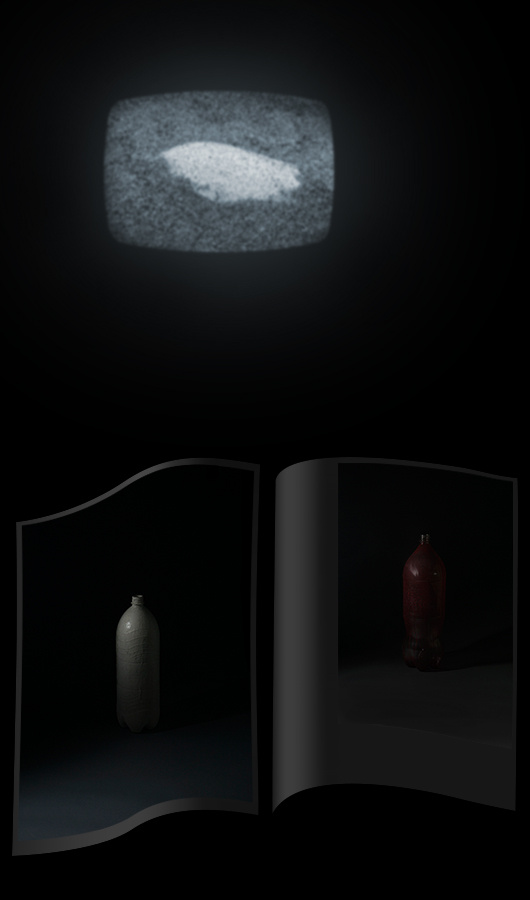
Digital composite image based on staged photograph with found plastic bottles, sand, and acrylic paint
2015
Digital composite image based on staged photograph with found plastic bottles, sand, and acrylic paint
《That Night, What Did the Father Say Downstairs?》源于成年以前熟悉的夜间记忆:房间外的灯光、隐约传来的电视声,以及被噪音遮蔽、无法辨认的谈话。
画面中的“瓷器”实际由废弃塑料汽水瓶、沙土和丙烯制成。它们分别以拍卖行古董摄影和电视节目中考古发掘影像的方式进行拍摄,随后通过数字手段被合成为一个虚构空间。
作品通过双重替换重构心理场景:象征父辈审美和历史文化价值的瓷器被置换为廉价、临时、空的、可丢弃的塑料瓶;捕风捉影的警觉、焦虑与疑惧,则被置换为一个未知的伟大秘密的海市蜃楼:电视雪花、低分辨率影像、昏暗空间与画册中的物体不断暗示彼此之间存在某种联系。
That Night, What Did the Father Say Downstairs? draws on familiar nocturnal memories from before adulthood: light spilling in from outside the bedroom, the faint sound of a television, and fragments of conversation rendered unintelligible by surrounding noise.
The “porcelain” objects in the image were in fact fabricated from discarded plastic soda bottles, sand, and acrylic paint. They were photographed in two distinct visual registers—auction-house catalogue photography and the grainy televised imagery of archaeological excavation—before being digitally composited into a fictional space.
The work reconstructs this psychological scene through a double substitution. Porcelain, associated with a paternal world of taste and with historical and cultural value, is replaced by cheap, temporary, hollow, and disposable plastic bottles. In turn, a vigilance fuelled by conjecture, anxiety, and suspicion is transformed into the mirage of some vast but unknowable secret. Television static, low-resolution imagery, the dimly lit space, and the objects reproduced in the catalogue continually suggest that a hidden connection exists between them.